
The Market Budapest Didn't Build for You
If you want to understand how people in Budapest really eat, you have to go where tourists don't. Lehel is that place — the one they never think to look — but without a chef, most of it will look like noise.
Check Availability →Under 14 free · Ages 14–18 half price
All tastings, water & homemade pálinka included
Budapest Has Plenty of Markets.
Most Tourists Only See One.
Most food tours in Budapest go to the Great Market Hall. It's magnificent, it's worth seeing, and I take people there too — but now it's mostly for visitors, and it knows it. You will too.
Lehel was built for nobody but the people who live nearby. No souvenir stalls, no vendor shouting at you in English — but you might catch grandmothers arguing with butchers. Just a city feeding itself, the way it has for decades: loud, seasonal, completely uninterested in your approval.
That's exactly why it's worth going to. And exactly why most tours don't. You can't get a commission for pushing paprika, there's no infrastructure for tourists, and most importantly — it takes courage to show something this raw, this anti-guidebook.
If you don't leave with a deeper understanding of this city, you don't pay. That's been the guarantee since 2013.
A Friend Once Lived in Innsbruck
for Two Years Without Going to the Market.
I was genuinely outraged. We went within twenty-four hours.
I don't think you need to love markets to visit one — it sure helps though.
But if you want to understand a city — really understand how it works, what it values, what it refuses to let go of — you go to its market. In museums and stunning buildings you see the past. Walking the streets you see the city, feel it, smell it. But a market gives you all of it at once: past, present, and future. You don't just see and hear — you smell it, taste it. It doesn't tell you what to think or feel. It makes you.
Markets are where a city is honest. The produce reflects the season, the vendors reflect the neighbourhood, and the food reflects what people actually eat when nobody is performing for anyone. You can learn more about Budapest in two hours at Lehel than in a full day on the tourist trail.
I chose Lehel because it's the right market for this. Close enough to the centre that you'll actually come, big enough to be genuinely interesting, not yet taken over by overpriced artisan jams and weekend pop-ups — and most importantly, tourists have no idea it exists. It's a market. Nothing more, nothing less. That's exactly what it needs to be.
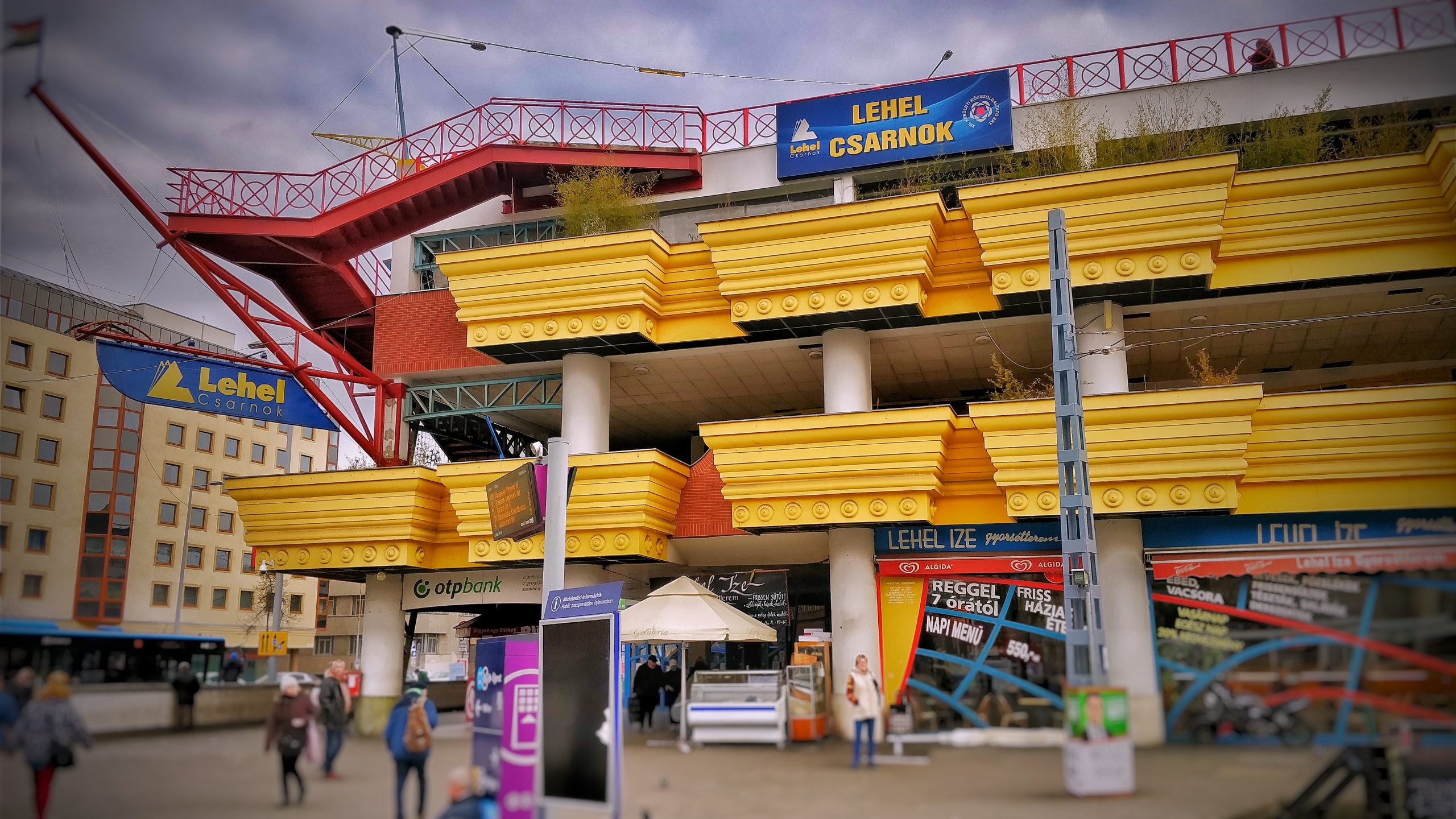
Not pretty. Just honest.
The Food Isn't Arranged for Tourists.
That's the Point.
At Lehel the food isn't curated for visitors — it's what people here actually eat. Every stop I choose makes sense in a market context: food that tells you something about how this city feeds itself, not food that photographs well.
You'll try lángos — proper crisp edge, soft fluffy centre, well-proofed and airy. You know it's good when you feel you could eat the whole thing on your own. Not that you should — but I understand if you do. It's a textbook example of a well-made lángos and I'll stand behind the fact that Lehel serves one of the best in the city. At the toppings display you won't feel lost — everything offered is there because locals want it. Not the tourist version where things get mixed together that have no business being near each other. Cheese. Sour cream. Feeling fancy: smoked meat. Feeling lonely: red onions.
We'll stop for sausages — classic, blood, or liver, depending on what's looking right that morning. Old-school flavours that have been feeding this city for generations. Eating sausage at a Budapest market is like eating a croissant in Paris — non-negotiable. The kind of place Jonathan Gold would have spent a Tuesday morning.
As we move through the market I'll walk you through the paprika story and show you what Hungarian home cooks actually reach for — and why. There'll also be pickles, strudel, pogácsa, and a few more surprises. Because sometimes you want to eat jam without a spoon.
One thing you won't find on this tour: goulash. Not because it isn't worth eating — it absolutely is. But goulash deserves a proper table, a slow cook, and the time to do it right. A market stop is not that time, and I'm not willing to do it badly just because it's expected.
We don't try everything. We try the right things.
Anyone Can Walk You Through a Market.
Not Anyone Can Read One.
A market like Lehel doesn't explain itself. There's no signage telling you what's worth buying or worth eating. It's just a city's appetite on display — raw, seasonal, and completely indifferent to whether you understand it or not.
That's where a chef changes everything.
I don't just see stalls. I see what's in season, what's always there, and what's special when it shows up. I can tell what someone might be making just by looking at their basket. A market is part of a much larger system — through them you don't just understand a market, you get a glimpse into something deeper. Foodways that have been the way they are for generations. It took time to build them. It takes time to understand them. I can give you the shortcut.
I'm not there to perform expertise. I'm there because this is how I think about food every day. I cook with these ingredients, I know the logic behind them, and I can give you the context that turns a noisy, chaotic Budapest market into something you'll actually remember.
Without that context Lehel is just loud. With it, it's one of the most honest two hours you'll spend in this city.
The market doesn't curate itself. That's what I'm there for.
Not a Tour for Everyone.
Absolutely a Tour for the Right Person.
This tour is for the kind of traveller who still believes a city should be discovered, not consumed. Who prefers one honest conversation over ten curated stops. Who doesn't need the city to dress up for them.
If you've ever walked past a local market in a foreign city and thought I wonder what's in there — you're the right person. If you've ever eaten something unremarkable-looking that turned out to be the best thing you had on a trip — you'll understand exactly why Lehel works. If we share the mantra "if you didn't die or get arrested, it's a great story" — this might be the tour for you. I can't stress enough how off the beaten path and unique this experience is. If you want something you'll still be talking about months from now, this is it.
You don't need to know anything about Hungarian food before you arrive. Curiosity is the only requirement.
If you're looking for a polished, scripted experience with a clear beginning, middle, and end — this isn't it. If you're looking for an "authentic" experience — the word every tour operator in the world uses to describe their tour — this is so far beyond that it's ahead of it. If you want something easy to forget, this isn't one. Lehel is raw and occasionally chaotic, and I won't apologise for either. If that sounds uncomfortable rather than interesting, this probably isn't the right fit.
Not a tour for everyone. Absolutely a tour for anyone open to taste, learn, and discover.
Everything You Need
Before You Book
Private 2–4 guests: €59 · Private 4–8: €54 · Private 8–12: €49
Under 14 free · Ages 14–18 half price
Save over 10% vs booking through Viator.
Non-refundable within 24 hours
If you don't leave with a deeper understanding of this city, you don't pay.
No forms. No awkwardness. That's been the policy since 2013.
Some people do this on their last day. They leave thinking it was great. They have no idea what they missed. Do it on day one. Everything that follows - every market, every meal, every label you pick up - lands with context instead of noise, in Budapest and beyond. You'll go to a market and know exactly what to buy and why. You'll sit down to goulash and understand what you're eating. You'll pick up paprika and know how to read the label. One guest followed a market recommendation, bought the salami I pointed her toward - said it was some of the best she'd ever had. The earlier in your trip you do this, the more times it pays off.
Every Other Market Tour in Budapest Goes to the Same Market.
This One Goes Where Nobody Else Does.
The Great Market Hall is magnificent. It's also on every itinerary in the city. Lehel isn't — which is exactly the point. Here's how a chef-led tour of Budapest's most honest market compares to everything else on offer.
|
Budapest Market Tour
Chef-led
|
OTA Marketplace Tours (Viator, GetYourGuide) |
Independent Group Tours | |
|---|---|---|---|
| Lead guide | ✓Professional chef — Michelin-trained, guiding since 2013 |
–Rotating local guides, varies by booking |
~Knowledgeable locals — not professional chefs |
| The market | ✓Lehel — where locals actually shop, zero tourist infrastructure |
–Great Market Hall only |
–Great Market Hall only |
| Group size | ✓Max 6 small group · Private options available |
–10–20 people, shared with strangers |
~8–12, semi-private |
| Tasting philosophy | ✓Curated — every stop chosen for quality, context, and honesty |
–Volume-led — quantity as the selling point |
~Mixed — some curation, some padding |
| Storytelling focus | ✓One market, full depth — ingredients, technique, seasonality, culture |
–History and sightseeing with food as backdrop |
~Food-forward but broad |
| Flexibility | ✓Pace, questions, dietary needs adapted on the day |
–Fixed script, fixed stops, fixed pace |
~Some flexibility — depends on guide |
| Money-back guarantee | ✓Yes — if you don't leave with a deeper understanding, you don't pay |
–Platform refund policy only — not the guide's guarantee |
–Rarely offered by independent operators |
| Booking | ✓Save 10%+ vs Viator — you deal with the guide, not a platform |
–20–30% commission built into price |
~Terms vary widely |
| Kids | ✓Under 14 free · Ages 14–18 half price |
~Varies — usually full price or small discount |
~Varies by operator |
| TripAdvisor rating | ✓4.9 stars · Running since 2013 |
~Variable — depends on guide assigned |
~Strong ratings but group format limits depth |
| Years operating | ✓Since 2013 — same guide every time |
–Platform exists long — individual guides rotate frequently |
~Established operators — guide consistency varies |
✓ = clear advantage · ~ = partial or variable · – = not offered or inconsistent.
Competitor information based on publicly available listings as of 2026. Individual experiences may vary.
The Tour Ends.
The Story Doesn't.
You'll leave with a full stomach and a different map of Budapest in your head — not the tourist one, the real one. The side of the city most visitors never find, and fewer still understand.
You'll get a follow-up email with everything we tasted so you can stay present during the walk instead of taking notes. If something sparks a question three months from now — a recipe, a vendor, something you can't stop thinking about — you have my email.
There's also a rooftop recommendation waiting for you. The right place to sit down, look out over the city, and process the morning.
Chefs don't just feed you. We teach you how to taste.
Come curious.
I'll handle the rest.
You've made it this far — which already tells me something. You're not looking for a checklist or a scripted performance. You're looking for the Budapest that actually exists. I'll show you where it shops.
Check Availability & Book Your SpotAlso available: Great Market Hall Tour · Three-Market Deep Dive
Questions
Worth Asking
Lehel is Budapest's most honest working market — located in the 13th district, running almost entirely on locals. No souvenir stalls, no tourist menus, no paprika pyramids arranged for photographs. Just a city feeding itself the way it has for decades. It's not polished and it doesn't try to be. I've been running tours here since 2013 — if you want to leave the tourist trail and see Budapest the way its residents actually use it, this is the one.
The Great Market Hall is magnificent architecture and absolutely worth seeing — I take people there too. But it knows it's a tourist destination and it performs accordingly. Lehel doesn't know you're there and wouldn't care if it did. One is the city as it presents itself to visitors. The other is the city as it actually is. Both tell you something about Budapest — they just tell you different things.
Unsure which one to choose? The Three-Market Deep Dive solves that problem →Lángos fresh from the fryer, proper pickles, traditional sausages — classic, blood, or liver depending on the morning — and a few more things that show up because they're worth trying, not because they're on a list. Every stop is chosen because it makes sense in a market context: food that tells you something about how this city feeds itself, not food that photographs well. One thing you won't find: goulash. It deserves a proper table and a slow cook — a market stop is not that time.
A market like Lehel doesn't explain itself. There's no signage telling you what's worth buying or eating — it's just a city's appetite on display. A chef reads that differently. I see what's in season, what's always there, and what's special when it shows up. I can tell what someone might be making just by looking at their basket. I've been cooking with these ingredients my whole life. That context is the difference between walking through a noisy market and actually understanding one.
No — and deliberately so. Lehel is the market other tours skip precisely because it has no tourist infrastructure. No commission stops, no scripted route, nothing performing for visitors. I chose it because it's the right market for what this tour is trying to do: show you the Budapest most visitors never find. The kind of place Jonathan Gold would have spent a Tuesday morning.
Safe enough — which is to say, it's Budapest, not a theme park. The market itself is fine. That said, it's a real working-class neighbourhood and it looks like one: expect the occasional drunk at 9am and a few people who've clearly been there since the night before. Nobody will bother you. It's just honest in the same way the market is honest — it doesn't clean itself up for visitors. If anything, that's part of why it's worth going. Easy to get to from anywhere in the centre — exact meeting point and directions in your reminder email the day before.