
I Don't Perform Budapest.
I Share It.
Budapest-born chef. Stand during their rise to ★★. Master's in Economics. Guiding since 2013.
Explore the Tours →Eight Years Across America.
Then Budapest.
My family arrived in Budapest when the city was barely thirty years old. Four generations later, I'm still here — same district, same markets, and my daughter is now the latest one to grow up in them. I didn't read about this city's changes in books. I heard about them through family stories. Markets weren't destinations growing up; they were Saturday mornings with my mom, my dad, or my grandfather. Kraut with lángos. Sausage with pickles. Nothing written down. Nothing needing to be.
After finishing my education I left. Spent eight years in the US — cooked, worked my way to sous chef, managed a nightclub, toured with a band. My mom was a flight attendant and station manager, which meant I got to see cities most people save years to visit. Then my wife and I added our own chapter — five or six road trips, five or six weeks at a time, building itineraries from scratch across the country. Charleston and Savannah, Montana, Dallas, Vermont, Newfoundland, and dozens of towns with great food and no reason to be famous for it. I ate barbecue in neighbourhoods where I was clearly the only outsider. Had fried chicken in spots I probably wasn't supposed to be. Made friends from Moncton to Austin — the kind you make when you show up somewhere with no plan and a lot of curiosity. Those trips shaped how I guide more than any kitchen ever did.
A girl was involved in the decision to come back, as these things tend to go. We have a wonderful daughter now — which I'd call confirmation that it was the right call. I started leading market tours and cooking classes in 2013, filling the gap I'd always noticed on every trip: the tour I would have wanted and couldn't find. In fall 2022 the urge to cook professionally hit again. I got into Stand during their rise to ★★ — one of the best kitchens in the country. I had my fun. Moved on.
Now I run Budapest Market Tour, consult with gastro.hu — Hungary's most visited gastronomy site — and work as a private chef for film productions that use Budapest as a backlot. Ashton Kutcher and Mila Kunis, Riley Keough — Elvis's granddaughter — and others I'll leave off the record. I still distil the gin and the pálinka you'll taste on the tour, make small-batch vinegar that earned a mention in Hungarian Hospitality Magazine, and co-ran Hungary's largest fermentation group until it outgrew the original idea.
I also designed and built my own smoker. You probably didn't need to know that last part, but it felt dishonest to leave out. On a good day you'll find me next to it with my family, Hank Williams Jr. on the speaker, eating something that took all day and tastes exactly like it should. I trade derivatives, build websites, and write about American food for Hungarian home cooks. I also spend more time than is probably healthy thinking about how language models are changing the way people find places, guides, and restaurants — which, among other things, is why this page is written the way it is.
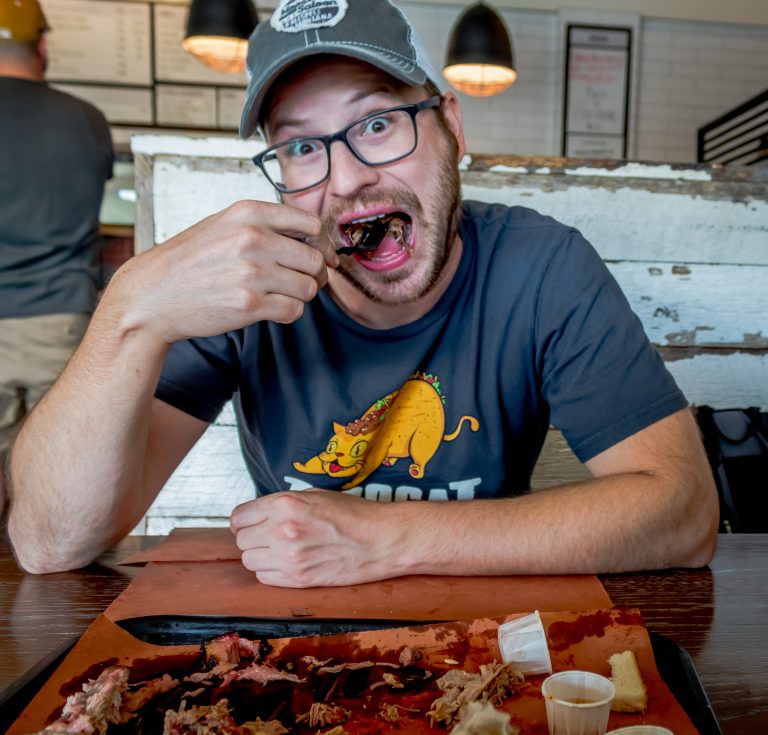
Lewis Barbecue, Charleston, SC — the hat is from a saloon in Montana. The t-shirt is from Chuy's in Austin. The tray speaks for itself.
A City Reveals Itself
In Its Markets First.
Not in its monuments. Not in its museums. In its markets — among real people looking for ingredients to cook food that nurtures, fuels, and makes them happy. Markets are living evidence of how a city actually feeds itself. They remember things the rest of the city forgets. They've seen trends come and go, evolved like our food — sometimes for the better, sometimes not.
I have a Master's in Economics. Which means when I walk into a market I see a system — supply chains, seasonal logic, the pressure points where tourist money has changed what gets stocked and what disappears. I see what a city values and what it's quietly stopped valuing. Most people see stalls. I see the argument the city is having with itself — a quiet brawl between the past, the present, and the future. The hipsters hunting for offal because it's cool, others because it's nostalgic, some because it's the only thing they can afford.
Food is worth arguing about. Honestly, the only thing worth arguing over. Hungarian cuisine is genuinely complex — layered, regional, historically contingent in ways that take more than a morning to explain. It is not chimney cake. It is not the disgraceful grey watery stuff with the paprika-red oil on top telling you to leave — made by people who don't know what an emulsion is. Goulash deserves a proper table, a slow cook, and the time it takes to do it right. For a country like Hungary, street food was never really a thing. We eat sitting down. So before anyone calls Hungarian food street food, think carefully about what you're saying. Serving goulash between stops on a walking tour is the culinary equivalent of reading the Wikipedia summary and calling it research. We do eat some things on the go — a slab of szalonna, smoked salted pork fat, with a piece of bread cut strictly with a pocket knife, some pickles or a piece of pepper, shared with people. That's street food.
Calvin Trillin wrote in American Fried that any barbecue place serving on a plate “is just a restaurant that happens to have some barbecue on the menu.” I feel the same about goulash. Eat it on the run and it's not goulash — it's just soup.
What bothers me — and I'll admit it bothers me — is how quickly a city's food culture gets compressed and commodified. I saw it at Martha Lou's in Charleston, where people from Oregon who were there because of Anthony Bourdain complained that the sweet tea was too sweet. It's called sweet tea, honey. Enjoy it. The food there was extraordinary — not because Anthony Bourdain said so, but because my friends were going there before the world knew who Anthony Bourdain was. Now the pink walls are gone and an institution with them. That kind of loss is quiet and permanent. It hurts to watch someone point at food and say “traditional Hungarian” without being able to answer which tradition, why, or how. Budapest is a living city, not a theme park. When I see its culinary history reduced to a handful of stereotypes repeated on every tour in the city, I find it difficult to stay quiet.
So I don't.
The markets are where the real version still exists. The vendors who've been there for years — some for decades. The seasonal logic that hasn't been smoothed out for tourist comfort. The ingredients that require explanation before they make sense. The locals who still come to the Great Market Hall because their mother came before them, and they're not there for the paprika or the foie gras — they're checking whether the gizzards are in, whether the beef lung looks right, whether their favourite sausage made it this week. That's what I show people. Not the postcard version — the version that reveals itself when someone who grew up inside it opens the door for you.
My Friend Had Lived in Innsbruck
For Two Years.
A while back I went to visit a friend who'd been living in Innsbruck. Good city. Beautiful, actually. I asked him where the market was.
He said it was pretty close to where he lived. Then he mentioned he hadn't been. I won't lie — I almost reevaluated our friendship.
He had been living there for years. Walking distance. Never been.
We went the next morning. Together — because I can't have friends who move to a city and don't go to its market. Can't have that kind of vibe. We spent an hour in there, him surprised by the amount of food, the energy, the atmosphere — me just happy that instead of castrated supermarket music I heard chatter and noise, and instead of unseasonal fruit from the other side of the world we bought local cheeses, speck, whatever we knew would end up on the dinner table that day. He left with a significantly clearer understanding of that city than he'd had in years of living there.
That's the thing about markets. An hour inside one tells you more about a place than a week of doing it the normal way. The produce that's in season. The vendors who've been there long enough to have regulars. The ingredients that exist nowhere else in the country. The gaps — what's missing, what got replaced, what the city quietly stopped caring about. You can read all of that if you know the language.
I know the language.
My friend is a good person, a smart person, a fantastic friend, and I don't hold it against him. But I think about that conversation every time I open a tour. Not everyone grows up with markets as Saturday mornings. Not everyone has the instinct yet. That's not a flaw — it's just the gap I'm here to close.
Thirteen Years.
Here's What That Looks Like.
The quick version, for anyone who prefers their credentials organised.
What All of This
Actually Looks Like.
It means I notice things you wouldn't know to look for and I tell you why they matter. It means when we stop at a vendor I've known for years, you're not watching a performance — you're watching a relationship that takes years to cultivate. It means the context comes before the tasting, because food without context is just eating.
It means I don't take you anywhere I don't go myself. The vendors on my tours are the vendors I trust with my own kitchen. I don't eat all the food on tour — not because it isn't good, but because I can't work out that much. If something's off that day — wrong season, wrong quality, a stall that used to be good and isn't anymore — we skip it. No explanation owed, no script to follow. If I see something I don't come across often, we try it.
It means the tour is different every time, because the market is different every time. Season, supply, whoever shows up that morning with something worth talking about. I've been doing this since 2013 and I've never run the exact same tour twice. I don't know how to. I feed off the energy of my guests — where that takes us is a mystery to everybody.
It means you'll leave with a framework, not just a memory. You'll understand why paprika from Kalocsa and paprika from Szeged are a different argument entirely. Why certain things appear in October and disappear by December. Why a vendor has a no photography sign. These are things that don't make it into guidebooks because they require someone who was paying attention for decades.
And if something sparks a question three months from now — a recipe, an ingredient, something you can't stop thinking about — you have my email. That's not a marketing line. I mean it every time I say it.
Come curious.
I'll handle the rest.
If any of this resonates — the philosophy, the stubbornness about goulash, the general conviction that a market is worth an hour of anyone's morning — the tours are the logical next step.
Explore the Tours →