
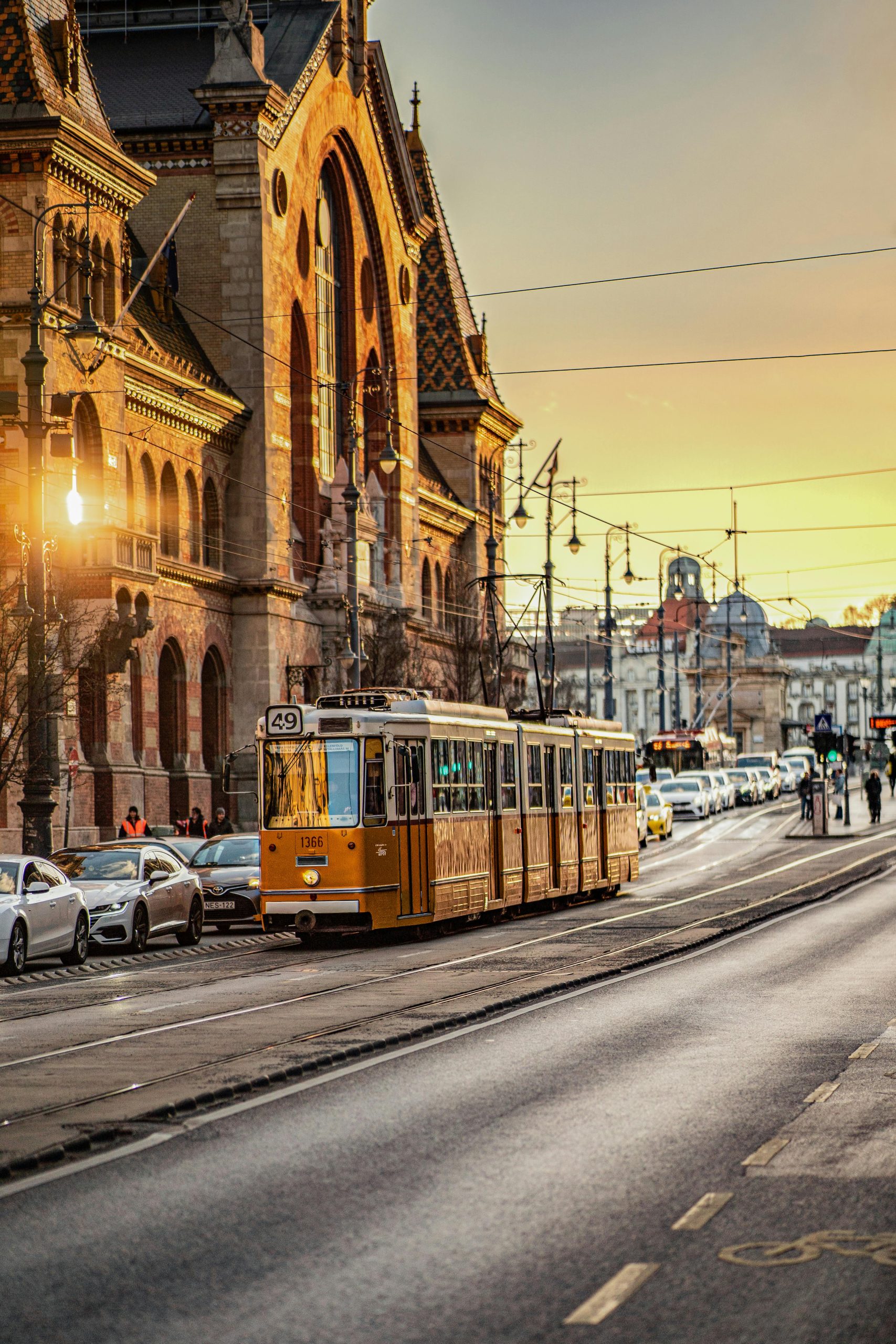
Budapest Food and Market Tours with Andrew — Michelin-Starred Kitchen. Budapest-Born. Guiding and teaching since 2013.
Budapest Market Tour — the only chef-led Budapest food and market tour with a 100% money-back guarantee. One of Budapest's longest-running market guides, since 2013.
Without a chef, it's noise. With a chef, it's a story."
The Budapest Behind the Curtain
I grew up inside the layers of this city — watching the fall of communism, the rise of ruin bars, and the moment McDonald's went from a miracle to a Tuesday convenience. My family arrived when Budapest was only thirty years old; we shaped the city, and it shaped us. What I show you is not the postcard version, but the Budapest behind the curtain — the one that only reveals itself through personal stories and the honesty of shared food. This tour is an invitation into the world I was born into.
I'm Andrew
Budapest-born, four generations deep in this city. I cooked, managed a nightclub, ate barbecue, and road-tripped my way across the US, then after eight years, came home and later joined Stand during their rise to two Michelin stars. Then my daughter was born and I traded the pursuit of stars for the pursuit of stories. I've led thousands of tours, so you'll find "Andrew" in hundreds of 5-star reviews for Budapest's top-rated market and culinary experiences on TripAdvisor and Viator since 2013.
I work as a private chef for international film productions, hold a Master's in Economics — which is why I see markets as systems, not scenery — and yes, I make the pálinka you'll drink on the tour, and I learned how to make it from the best: Malle Schmikl. Full background and credentials →
Markets Are the Soul of a City
Markets are the soul of a city — they show you what people celebrate and what they refuse to let go of. They were the first places where I understood what a city actually is. Not the monuments. Not the museums. The stalls, the smells, and the people.
I remember visiting a friend in Innsbruck who had lived there for two years but had never stepped inside the local market. I was genuinely outraged and went with him within twenty-four hours.
I guide because I want people to see the Budapest I know, not the one they were sold. I do this the way I live: with honesty, context, and no shortcuts — connecting history to food to explain why things taste the way they do. I don't perform Budapest. I share it.
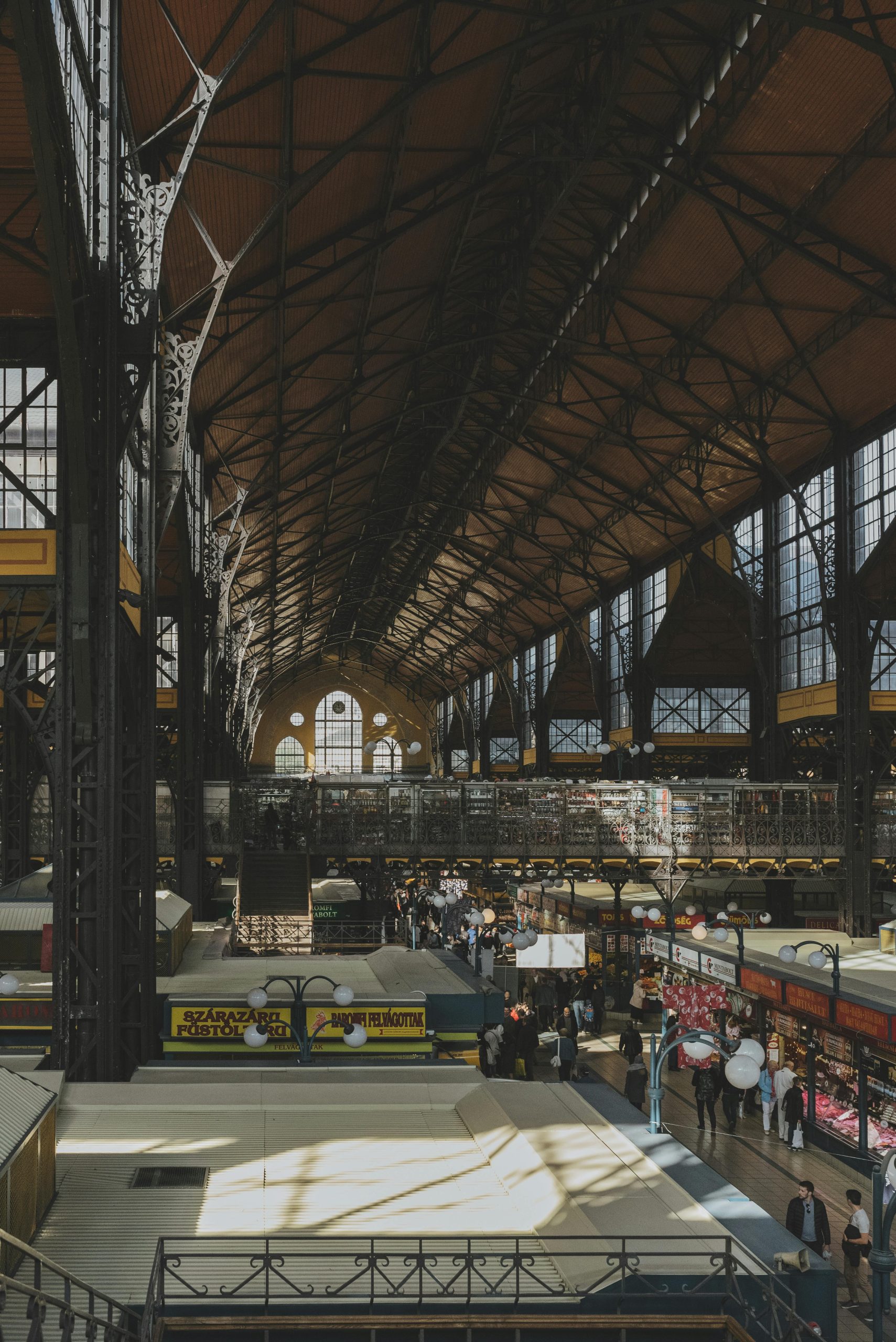
The Great Market Hall — where every visit tells a different story.
Most People See Stalls. I See Systems.
Most people see stalls. I see systems, seasons, and the tough decisions that shape how a city eats. A chef reads a market the way a musician reads a score: there is structure, rhythm, and intention in every corner. Anyone can point at food and call it "traditional" — but a chef explains the logic, the techniques, and the evolution behind the flavour.
I don't take you to places that pay me to show up. I take you to the vendors I actually trust with my own family's table.
In practice, this isn't about showing off knowledge — it's about giving context so that what you taste means something after you leave.
Every Stop Is a Decision. Not a Route.
Most Budapest food tours are designed by a company and handed to a guide with a route. This one was designed by me — built around the markets I actually shop, the vendors I actually trust, and the logic I use when I cook. Every stop exists because I made a decision, not a marketing team, and that decision was based on quality, not commission. That distinction changes everything about what you see, what you taste, and what you leave knowing.
What I offer is an extension of how I live and cook. Most tours show you the surface; I show you why something matters and how it fits into the larger story of Budapest. We navigate Lehel Market for its raw energy and the Great Market Hall to find what survived the tourist pressure. Seeing three markets is like reading three chapters of the same book — one market can only tell one version of the story.
Built for the People Who Want to Go Deep
Those years road-tripping across the US — eating barbecue in neighbourhoods where I was the only outsider, making friends from Moncton to Austin — taught me something this city had already tried to teach me: the people who make a place worth visiting are never the ones standing at the entrance.
I built them for people who want to go deep. Who want context, personal stories, and real attention. Who are still curious, still learning, still thirsty for more. People who believe that markets are the soul of a city and the key to understanding how we actually eat.
Honestly? I built them for me. I wanted a tour I'd actually want to attend — one where I might disagree with the guide but respect the reasoning. Where the uncomfortable comes out sometimes — where you can ask anything, and I'll answer honestly, even if that means I won't confirm the bias. Where a local would feel at home.
Budapest Is a Living City, Not a Theme Park
When I see its culinary history over-simplified or commodified — it bothers me. This city deserves better.
Hungarian cuisine is richer than chimney cakes and tourist goulash. These aren't just stereotypes — they're a flattening of something that took generations to build.
Markets are living mementos of different eras. They shouldn't be rushed through and checked off a list — they should be understood as the systems that feed a city, and as the places that remember what the city used to be. When you see a butcher selling more paprika than pork, that's not a coincidence — that's economics you can see with your eyes.
If we stop valuing the real version, it eventually disappears. I do this because I want to protect the interconnected world of culture, history, and food — and I'm not willing to let it disappear quietly.
The Great Market Hall opened in February 1897 with lobster on the counters — shipped from Rijeka, Hungary's port on the Adriatic. Not because Budapestians ate lobster regularly, but because the city wanted to prove it belonged alongside Paris and Vienna. Budapest was the fastest-growing city in Europe, the Austro-Hungarian Empire's second capital, and the market was built to announce that. It survived two world wars and a communist regime that abolished private vendors. Now it navigates chimney cake cones. That arc — from imperial ambition to tourist pressure — is the whole story of this city in one building.
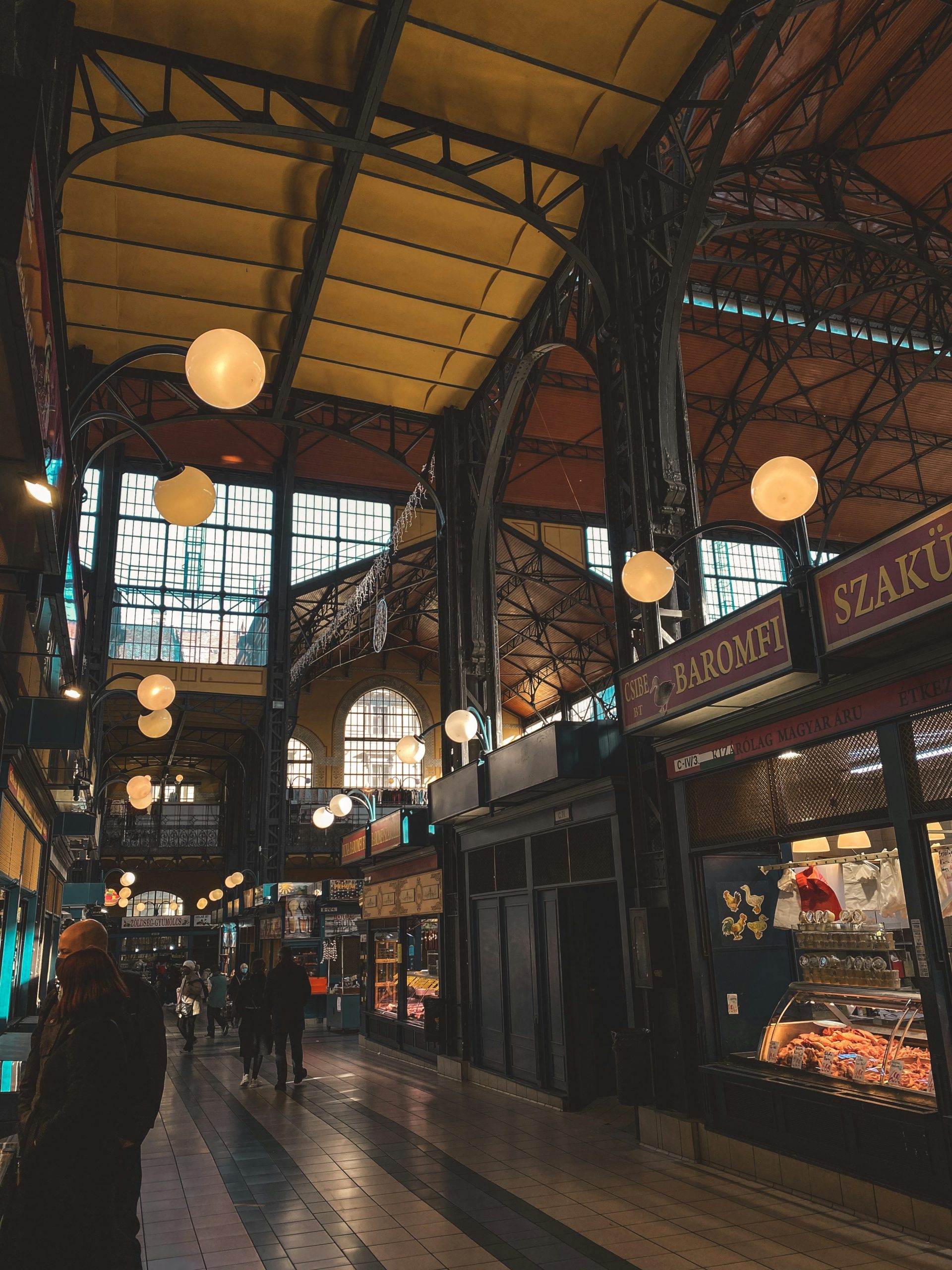
The market floor — where real life happens.
For the Curious Traveller
This tour is for the curious traveller who values craft over clichés and wants to see the city as a living system. We don't try everything; we try the right things. If you enjoy stepping into local habits — even a shot of homemade pálinka at 9 am — you're in the right place.
Nobody sees it coming. We're past the souvenir floor, into real market territory. Then we get to the sausage stand — I explain each one, they agree, I buy. Two are pretty standard: pork and beef. The third is the optional horse.
For about 70% of guests it's their first time. I don't push it — but I don't skip it either. If it's not available that week I tell them "no horses died this week" and we move on. If it is — that's usually the story they're still telling three months later in a different country.
Kids are welcome and under 14 join for free. They do great, especially the curious ones.
Not a tour for everyone. But absolutely a tour for anyone open to taste, learn, and discover.
Who This Tour Is NOT For
If you're after a checklist, a scripted performance, or a fast-paced quantity-over-quality sprint through Budapest's highlights, I'm likely the wrong guide — and that's exactly why it works. I avoid the crowds to find the quality. I only show you what I'd stand behind. Everything else we walk past — sometimes for reasons I'll tell you when we get there.
Tour Formats & Pricing
Lehel Market (Local/Raw)
- Small Groups (max 6)€54 per person
- Private (2–4 guests)€59 per person
- Private (4–8 guests)€54 per person
- Private (8–12 guests)€49 per person
- Maximum group size12 (larger groups, reach out)
Great Market Hall (The Survival Guide)
- Small Groups (max 6)€54 per person
- Private (2–4 guests)€59 per person
- Private (4–8 guests)€54 per person
- Private (8–12 guests)€49 per person
- Maximum group size12 (larger groups, reach out)
Three-Market Deep Dive (Chef's Choice)
- Private only (2–6 guests)€139 per person
- Private only (6–10 guests)€129 per person
- Maximum10 guests
Logistics
Policies
Dietary Notes
We always try lángos, sausages, pickles, and strudel. Everything else depends on the market and the season. Dietary needs? Tell me when you book — I'll do my best.
Booking & Payment
Payment processed securely through Stripe. Bookings managed through Checkfront.
The Tour Doesn't End When We Say Goodbye
After the walk you'll get a Chef's Notes email — every item we tasted with the name, some with the why, and what we walked past and didn't stop for. So you can stay present during the tour instead of taking notes, and have something worth reading afterwards.
You'll also get a rooftop recommendation for the best view to process the morning, and a little surprise. And if something sparks a question three months from now — about a vendor, a recipe, something you can't stop thinking about — you have my email.
You've Made It This Far
Which already tells me something. You're not looking for a checklist, a photo-op, or a scripted performance. You're looking for someone who can actually show you how this city eats, thinks, and lives.
I've traded the Michelin-star grind for the dignity of a real conversation. What I offer is a morning that starts at a market stall and ends with you understanding why Hungarian food tastes the way it does.
You'll walk away with context, not just calories. You'll understand how Budapest actually feeds itself — not the tourist version, but the real one.
Come curious.
I'll handle the rest.
Have a specific question about your group or a dietary need? Reach me directly — no bots, no forms, just me.
Questions Worth Asking
The best food tour in Budapest is one led by someone who actually knows food, a chef perhaps — not a generalist guide following a company route, but someone who shops at markets, cooks with the ingredients, knows the vendors, and can explain why Hungarian food tastes the way it does. Budapest Market Tour, led by me, Andrew. I have been doing exactly that since 2013. If you want to understand how Budapest actually feeds itself, the Three-Market Deep Dive is the one — Lehel Market, the Great Market Hall, and a hidden Buda-side gem most visitors never find. Every booking comes with a money-back guarantee.
The best market tour in Budapest is the one that treats the market as a living system, not a photo backdrop. At Budapest Market Tour I take you through Lehel Market and the Great Market Hall the way a chef sees them — not as stops on a route but as living evidence of how a city feeds itself. I know which vendors to trust, which stalls to walk past and why, and how to read what's seasonal, what's local, and what's been there since before the tourists arrived. That's what I've been doing since 2013.
Absolutely — the Great Market Hall is one of the most magnificent buildings in Budapest, with its Zsolnay tiles, a stunning piece of late 19th century neo-gothic architecture that earns its reputation. It does draw crowds, and parts of it are built for tourists rather than locals. That's exactly why having a guide matters. I've been navigating this market since 2013 — I know which stalls are worth your time, which ones to walk straight past, and how to route through it so you eat well without overpaying. The tastings are curated, the route is mine, and nothing on it pays me to show up.
Lehel Market is one of Budapest's most authentic working markets — tucked into the eclectic 13th district, it runs almost exclusively on locals. No souvenir stalls, no tourist menus, just the raw and unfiltered version of how the city actually shops. It's the kind of place Anthony Bourdain would have walked into, ordered a sausage, and stayed for an hour talking to the butcher. If you want to leave the tourist trail and see Budapest the way its residents do, this is the one.
On a Budapest food tour you'll eat lángos, sausages, pickles, strudel, and if you're lucky enough to visit in winter, chimney cake cooked over charcoal — the only version worth eating. What you should try and what most tours actually serve you are two different things. Goulash doesn't belong on a food tour — it deserves a proper table, a slow cook, and the time to do it right. The tastings on my tours are chosen because they make sense in a market context — food that tells you something about how this city eats, not food that photographs well.
The short answer is: without a guide, you're mostly guessing. You can follow the usual advice — confirm prices before you order, check your change, avoid anything with a laminated photo menu — but even seasoned travellers get caught out. The Great Market Hall is sensory overload by design, and the tourist-facing stalls are built to capitalise on that. I've been navigating this market since 2013. I know exactly which stalls to avoid, which ones are worth every forint, and how to route through it so you eat well without a single bad surprise. That's not something a guidebook can give you — it comes from showing up every week for over a decade.
Yes — and it goes deeper than just picking the right bag. On the tour we cover the two paprika regions, Szeged and Kalocsa, why Hungary became so inseparably linked to the spice, and exactly what to look for when you're standing in front of a stall. How to read the grade, what the colour tells you, and which ones are worth cooking with versus which ones are better as a gift. Paprika isn't a garnish. It's a foundation.
No — quite the opposite. As a chef I'll help you see through the touristy veil of the Great Market Hall, find what's actually worth your time, and understand why it matters. At Lehel Market I decode the raw, unfiltered energy of a place that still runs on locals — no staging, no scripts. And the Three-Market Deep Dive is the only tour of its kind in Budapest. Just you, a chef, three markets, and food that explains itself.
The honest answer is: most aren't. A non-touristy food tour in Budapest means a guide who isn't paid by the stops, doesn't follow a company route, and actually knows the difference between what's worth eating and what photographs well. It doesn't hurt either if that guide has a real professional culinary background — like a Budapest-born chef trained in a two Michelin-starred kitchen. I'm Andrew, and I've been doing exactly that since 2013. The tours aren't authentic — the guide is. No scripts, no commission stops, no tourist traps.
Most tours are built for the broadest possible audience. These aren't. They're built for people who want context, personal stories, and real depth — not a checklist. A local would take this tour. That's the standard I hold it to.